
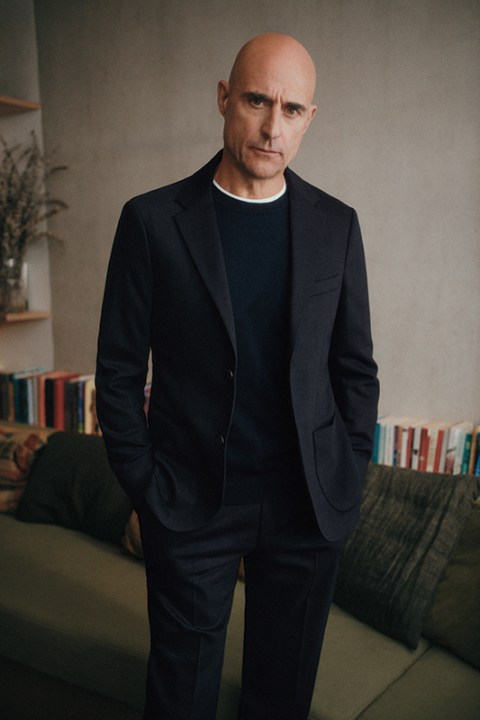
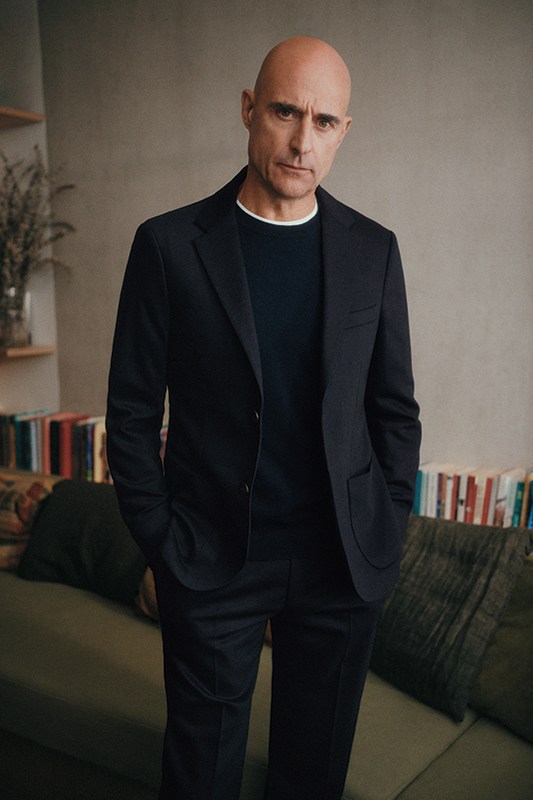
As a young actor, Mark Strong says he learned some simple lessons. “Don’t believe the hype. Firstly, remember why you became an actor. For me it was about mastering the work, not becoming famous.” That’s the least interesting bit, he says – something he discovered quickly.
Strong is one of Britain’s most respected actors, working pretty much nonstop on stage and film for nearly 40 years. With little appetite for celebrity, despite working alongside the breadth of Hollywood royalty, his credentials may be A-list but, refreshingly, he operates on a strictly no-list policy. Instead, he’s quite possibly one of the most down-to-earth people you could meet. And I really don’t think he was acting that part when I met him last month.
But he has played soldiers, aristocrats, morally compromised power brokers, scientists, policemen, spies, villains, and supervillains, among others. A character actor of significant range, he has pinballed between British television, classical theater, prestige cinema and Hollywood blockbuster. His lengthy rap sheet includes the films Stardust, Kick-Ass, The Imitation Game, Tinker Tailor Soldier Spy, Zero Dark Thirty, and Tár, alongside becoming a familiar presence in major studio productions and broad commercial entertainment franchises like Green Lantern and Kingsman. He’s also remained connected with the stage, where his performances in the 2014 Young Vic production of A View From the Bridge and this year’s Oedipus earned major critical recognition.
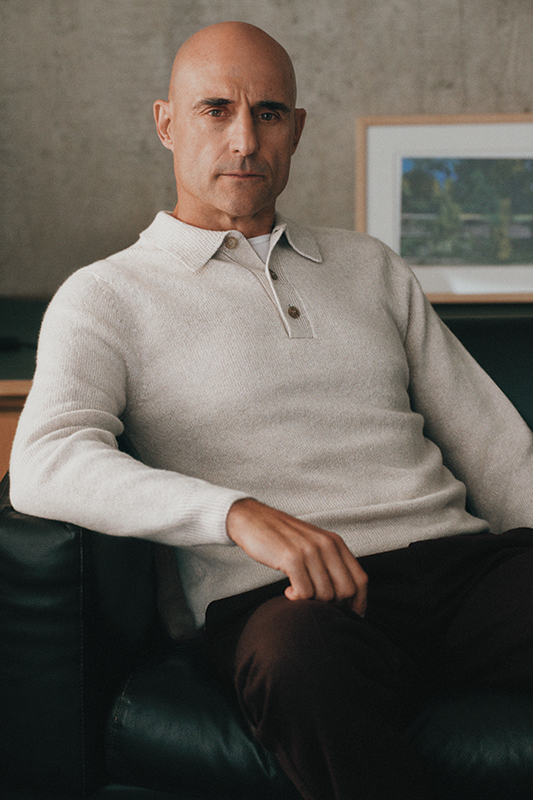
It is often said that to become a successful actor takes talent, luck, and a thick skin. In Strong’s case the first requirement is surely indisputable, and he’d agree with the second: “I think people get annoyed when I say I’ve been very lucky, but I say it genuinely knowing how difficult it is as an actor to find and get work and to be able to sustain a career,” he says. “It is very unusual that I’ve had just a very few periods when I wasn’t working.” His work ethic is robust: “I always think good work breeds work, and I kept working. So my choices weren’t what I’d call strategic. Some people come into the business and do one show, become very famous, and don’t work for ages as they’re waiting for the next part like a chess move that takes them higher and further. That can be a plan if you have the good fortune, and agent.”
Luck was more elusive when growing up. Born in London in 1963, he was originally named Marco Giuseppe Salussolia, the only child of an Austrian mother and Italian father who left when he was very young. “My mum was a single parent and very young. I was proving a handful and getting into a bit of trouble, and someone advised her she should find some way of getting discipline into my life,” he says. “From the age of five or six I went to a state boarding school.”
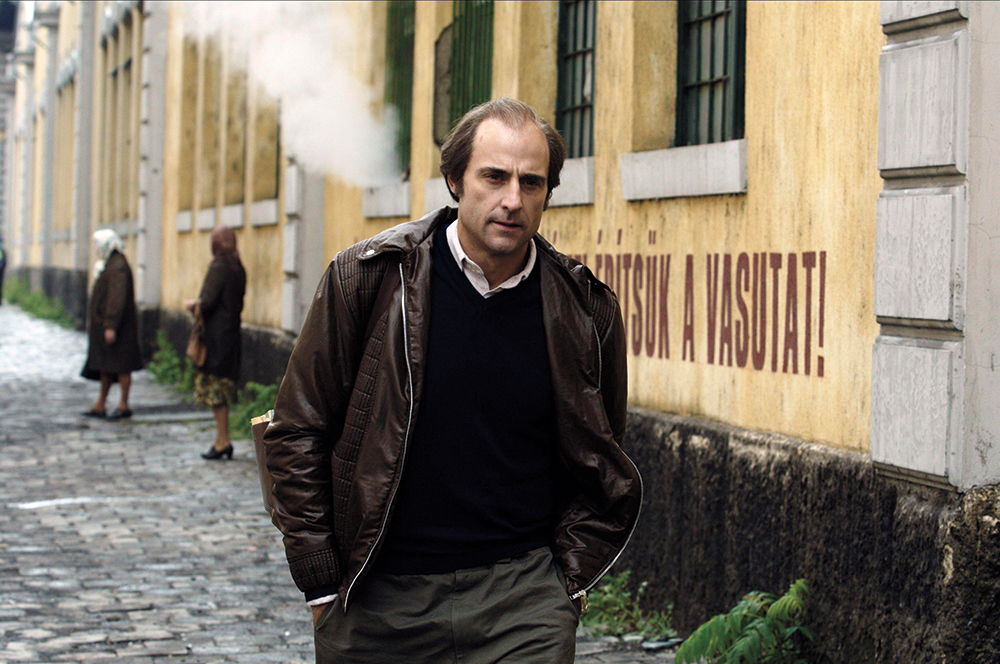
Later on at school he discovered punk and, playing bass, formed a band that performed a few times. “It felt very satisfying. It could be that was where I got the bug for performing – I didn’t feel self-conscious or uncomfortable fronting a band. Maybe that’s where I got the confidence to do acting.”
‘Someone said be careful you don’t get typecast as the bad guy and I thought well, is that so bad?’
A fluent German speaker, he studied law in Munich where his mother was living, but after a year knew it wasn’t for him. That abandoned legal career now seems almost like an alt-universe explanation for the actor he became. Strong has the qualities of someone who might have thrived in a courtroom, like an instinct for understanding the psychology of the person sitting opposite him. Instead, he found drama.
“I fell into acting. I realize now in retrospect how naive I was,” he says. “I was able to make that choice because there was nobody telling me what to do. I didn’t have a family structure that had parents or siblings, or anybody in the country even, no set path to follow what a family member had achieved. So I was able to choose or invent what I wanted to be.”
Law’s loss was acting’s gain. There was no epiphany, or repressed ambition. “I wasn’t an avid theater or filmgoer, but then we couldn’t afford it,” he explains. “Deciding to be an actor with naivete meant I just kept going without any sense of fear. I went to study drama at the Royal Holloway College in London where there was a studio theater – and that got me hooked.”
While training at Bristol Old Vic Theatre School, luck intervened: “I had a really good part in a leaving year play that an agent came to see – playing Berowne in Love’s Labour’s Lost, which is quite a showy part,” he recalls. “So, I got an agent and almost immediately got a call from the Worcester Swan Theatre asking if I wanted to come and get my Equity card there. I signed up for nine plays in nine months.”
Armed with his vital union card he began building a career initially rooted in British theater and television, a traditional apprenticeship in repertory theater, learning how to command the room, honing his craft at the Royal Shakespeare Company, working with the great names of the British stage, loving it. He appeared at the National Theatre in productions ranging from Shakespeare to Arthur Miller, winning the Olivier Award in 2015 as Eddie Carbone in Miller’s A View From the Bridge, a role he took to Broadway, earning him a Tony nomination, just as he did this year with Oedipus.
‘You have to have presence on the stage to earn the right to be looked at’
His stage work gave him the skill that would later distinguish him on screen: an ability to suggest an entire history with very little outward display. With his deep, measured voice and controlled gaze he has built a career out of characters who often appear to know more than anyone else in the room. Strong isn’t interested in the idea of what some actors call “process.” Instead, he says he takes on a character “as it comes,” relying on instinct. For him, it’s more about being an “artisan” actor: “I hear people talking about being creative artists and that doesn’t sit with what I’m doing. It’s much more pragmatic, and more enjoyable.”
Meanwhile, television established him as one of those actors whose presence could elevate an entire production without necessarily making him its headline attraction. Early appearances in British staples like The Bill and Prime Suspect led to Our Friends in the North, the celebrated BBC drama in which Strong acted alongside Christopher Eccleston, Gina McKee, and Daniel Craig. He played working-class Tosker from Newcastle, whose dreams of prosperity repeatedly collided with reality. Then came The Long Firm, with Strong in a standout role as Harry Starks, the charismatic and vicious East End gangster – a character both seductive and repellent, capable of charm and terrifying violence.
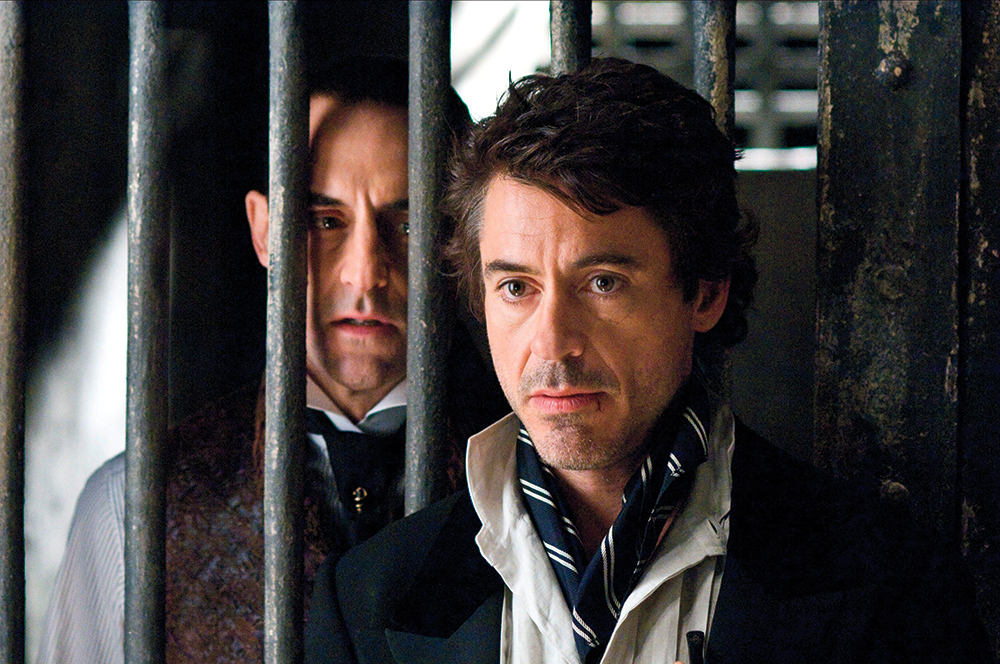
Filmmakers were beginning to recognize what Strong’s combination of restraint and presence could do. Roles appeared for Syriana, Guy Ritchie’s Sherlock Holmes, and as a crime boss in Kick-Ass. Then came Tinker Tailor Soldier Spy in 2011, one of his favorite parts. As Jim Prideaux, the wounded British agent at the center of John Le Carré’s intricate world of betrayal, he gave a performance built from control, with the character’s physical pain held inside the body.
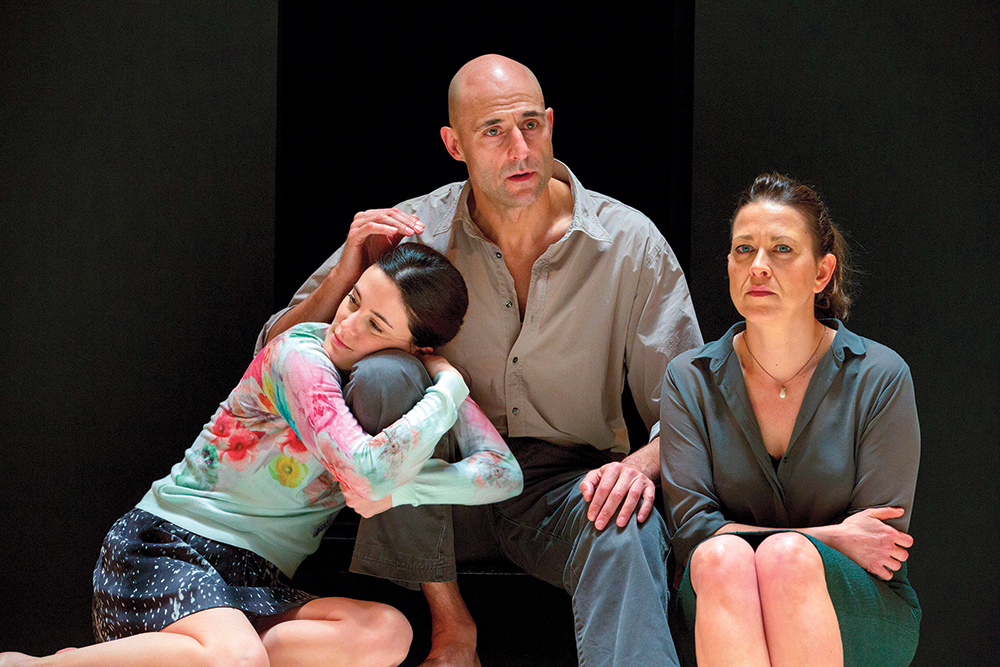
He majors in nuance and implication, finding new dimensions, exploring tensions, say, between authority and vulnerability. This approach has allowed him to play evil without turning it into pantomime. The characters seem violent because Strong suggests that violence is simply one weapon in his arsenal. “I played good guys for ages and then I played a really good bad guy and then just got offered bad guys. I remember someone said be careful you don’t get typecast as the bad guy and I thought well, is that so bad? They get the best parts, best lines, best clothes. I’ve always felt to get as far from myself is what I want as an actor. It’s definitely other, so interesting for me to play, and explore that psyche.”
Upcoming work suggests he could be transitioning from villain to cleric – “I’ve obviously reached the age where I now play religious figures,” he laughs. He becomes a cardinal in Tom Ford’s much anticipated film of Anne Rice’s novel, Cry to Heaven. Out later this year, it’s set in 18th-century Italy, in the world of opera and castrati, with a cast including Julianne Moore and Colin Firth and features Adele’s acting debut. He gets promoted to a 13th-century pope in David Lowery’s Poor Clare, with Isabella Rossellini. And then this month [September] he’s excited to start working on a film with director Jim Jarmusch – though I’m not sure this follows the devotional trend.
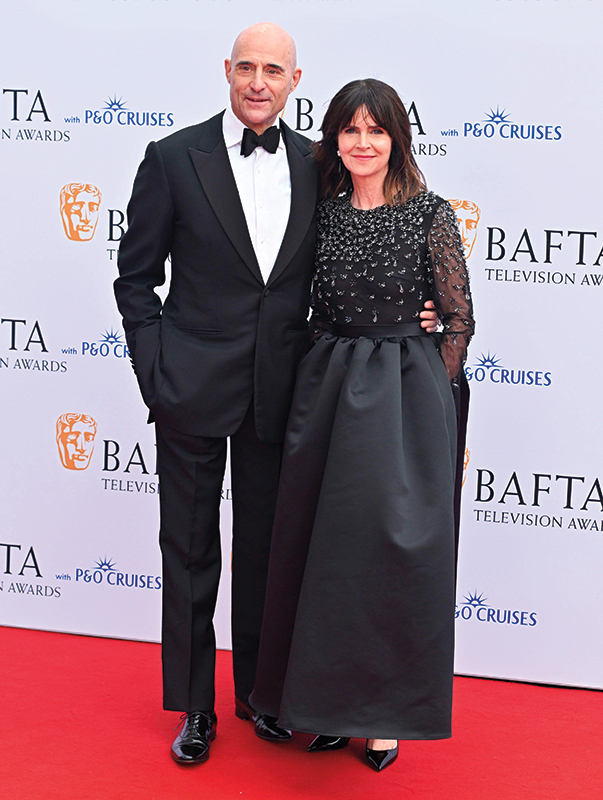
Costumes, he says, are a very important element in the way he approaches a character. Strong enjoys looking good, particularly as he dresses up for a living. Now, at the age of 63 – while looking a decade younger – north of 6’2”, he keeps toned and lean with gym sessions and some regular football playing (which he also watches – Arsenal is a passion). His style is dapper. “I’m in the fortunate position now to know what I like. There are a few brands I have relationships with, like Sunspel. Their fabrics are amazing, the colors, it’s not branded, quite simple and timeless and classic. That’s what I love about that brand. Same is true of Huntsman, I have a couple of suits – the cut with a broad shoulder and slim waist is a look I like. I formed a relationship with them when I made Kingsman.”
At home in north-west London with his wife Liza Marshall, the film and television producer best known for producing last year’s Academy Award-winning Hamnet, and their two sons, aged 21 and 19, both of whom have acting ambitions, Strong is looking forward to future work. At some point he will take on Macbeth, directed by Robert Icke, whose political-thriller Oedipus adaptation stormed in London and New York, and has eyes on Richard III, and Lear.
The hard work – not least all those early years spent learning how to hold a theater audience’s attention – has paid off. When Mark Strong appears in a film, whether his screen time is five minutes or 50, he brings the bearing of a fully formed person, one who exists beyond the frame. “You have to have presence on the stage to earn the right to be looked at,” he says. A Strong presence, indeed.


Comments