
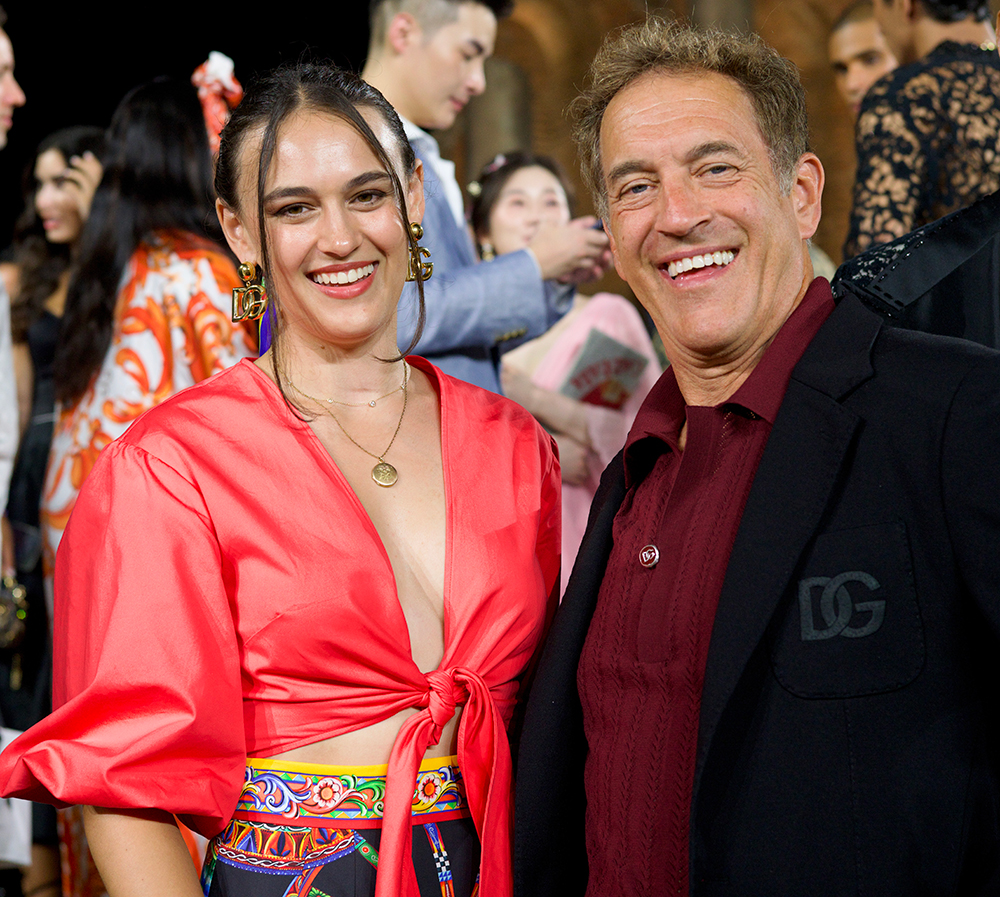
A pair crosses in front of the backdrop of the famous Teatro Antico, the Greek amphitheater in Sicily’s Taormina, to take their seats. This is David Glickman, the American CEO of private investment firm Glickman Capital and his daughter Riley, an archaeologist. Both are wearing decidedly Italian looks – he in a black blazer over a burgundy sports shirt and she in a red silk shirt over a colorful printed skirt featuring motifs inspired by Sicilian folk art.
Glickman, a New Yorker who counts Italian cashmere house Malo and Leeds United among his investments, says, “I buy a lot of their furniture, so I guess that’s why I’m on their radar.”
“They” in this case are Domenico Dolce and Stefano Gabbana, and the Glickmans, both rocking the brand, are here to witness the designer duo’s Alta Sartoria couture show for men. Being “on their radar” is important, as attendance is by invitation only to a select collection of customers. And a sprinkling of celebrities and press… cue Erling Haaland and Theo James.
‘This is the true Sicily; it is not about fashion but about a deeper sense of beauty’
Glickman and his daughter have come for the first time to this annual event, but many others have made the journey before, since Dolce & Gabbana inaugurated their Alta Moda program in 2012. Alta Moda (couture for women), Alta Sartoria (couture for men), and Alta Gioielleria (high-end, handmade jewelry) sit at the top of what Dolce & Gabbana creates: “We wanted to develop a kind of dream of special, beautiful design that would show Italian artisan skill and celebrate the long tradition of handmade craftsmanship that we have in our country,” says Stefano Gabbana. “And also, to use this as an opportunity to develop new kinds of artisan techniques too – this is not only theater, though of course it is that, too.”
So, in 2012, the label came to Taormina in Sicily, a region that has always inspired its aesthetic, and put on a women’s couture show for a small audience. The collection, which was rooted in the baroque history of the show’s setting, featured reams of black Sicilian lace as well as corsetry and full organza and tulle gowns adorned with intricately hand-painted or embroidered flowers.
At the time it was a radical departure for a global fashion label, where the trajectory of brand extension was almost always downwards towards a mass audience. In Dolce & Gabbana’s case, the development was even more marked, as it replaced the D&G diffusion collection, which had previously delivered a younger, more casual, and, yes, more affordable alternative to the main line. Now the designers were making a statement. Lest D&G send out the wrong message, diluting the firm’s reputation for serious Italian quality and design excellence, Dolce & Gabbana would confound that narrative by replacing it with the Alta Moda initiative. Here were collections that laid down a serious marker. While others went low, these guys would go high – they would go alta.
“The finance people in the business said it was a crazy idea,” recalls Domenico Dolce. “But we were determined to show who we are, and this was the way to do it.”
Since then, the Alta Moda show, along with its menswear and jewelry companions, has become an annual fixture. Every year it takes place in a different Italian location, reflecting the local culture and traditions: in Venice, decorative glass was used to reference Murano glassmakers; ecclesiastical embroidery featured in Rome; and a collection of Greco-Roman neoclassical styles was shown in Agrigento.
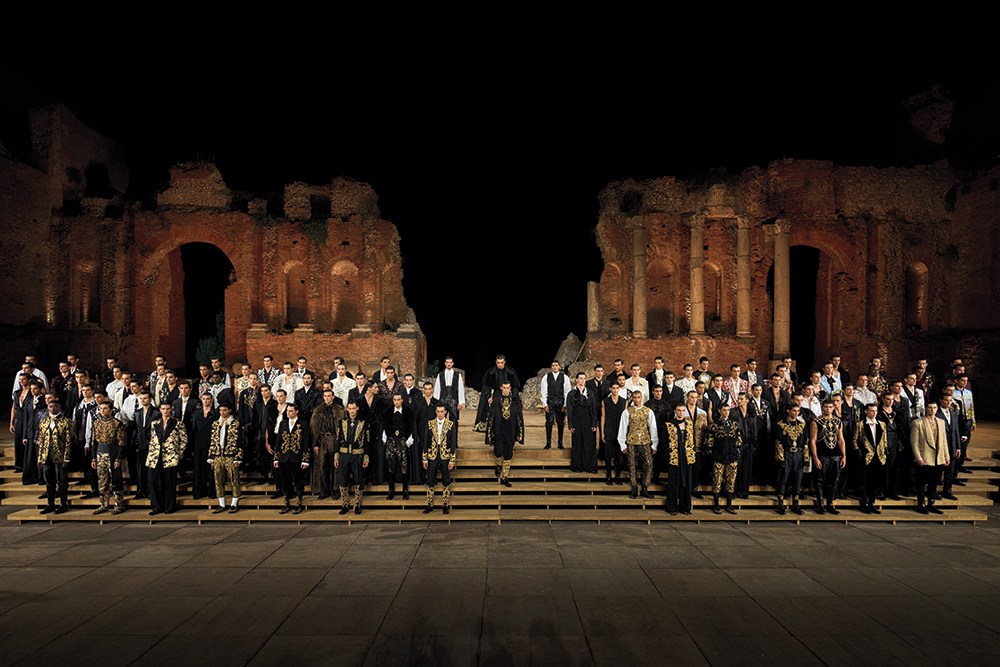
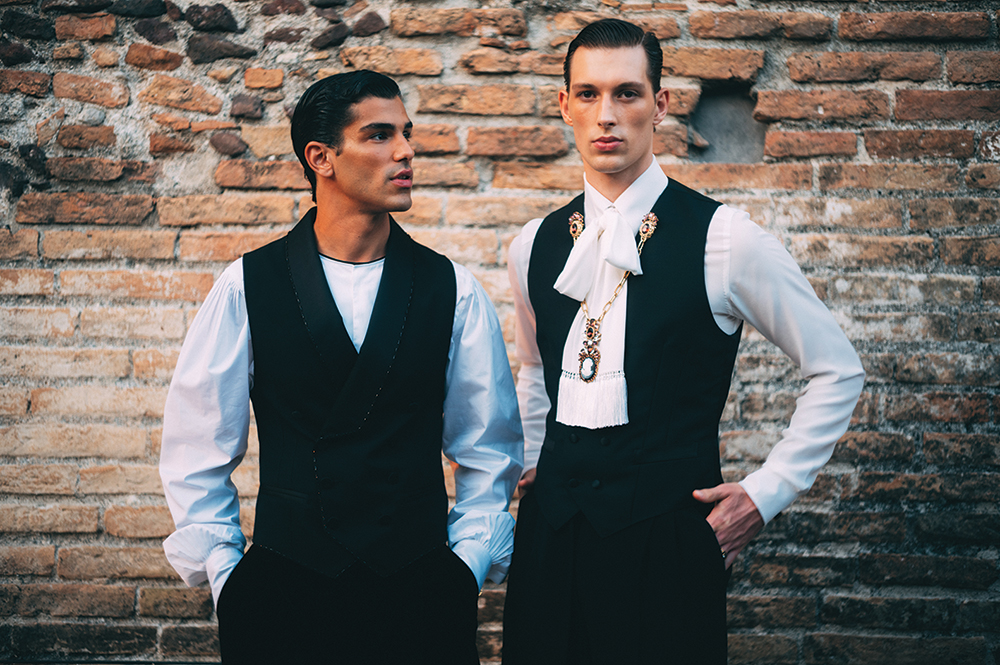
This year the Alta shows have returned to the island of Sicily, and the town where it all started. Here, among the ruins of an ancient amphitheater, a drama unfolds. Men in brown corduroy three-piece suits and flat caps, and women draped in black lace create the vibrant bustle of a town square, which is then interrupted by a procession of proxy aristocrats and nobles clad in highly decorative ensembles, all hand-painted fabrics and gold embroidery. The performance is accompanied by music from Pietro Mascagni’s 19th-century one-act opera, Cavalleria Rusticana, which is set in a Sicilian piazza on Easter Sunday.
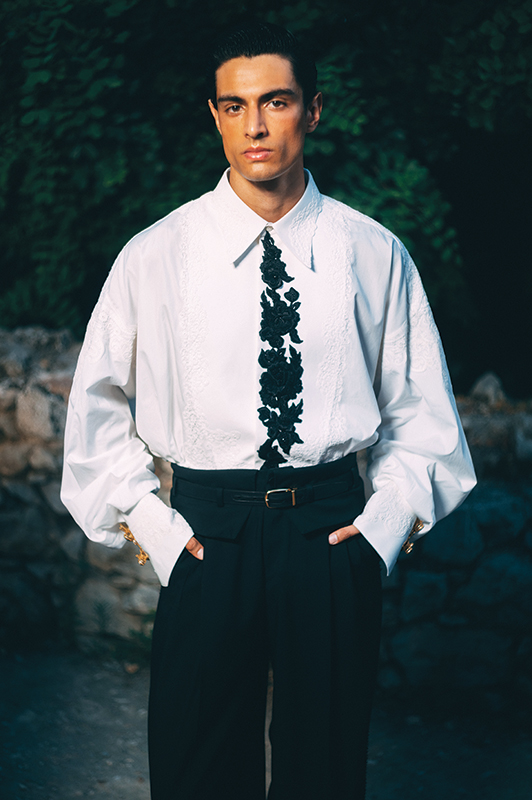
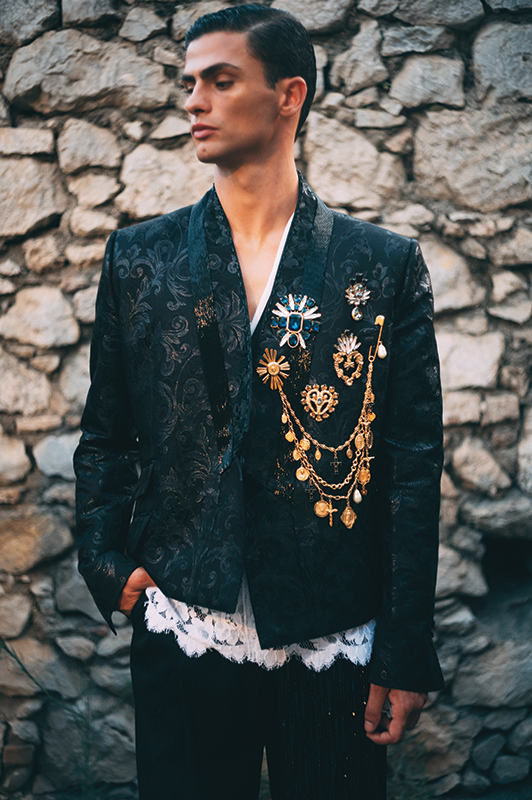
The handmade corduroy and lace worn by the townsfolk represents Dolce & Gabbana’s foundational look. The extravagantly embellished outfits of the nobility, meanwhile, where capes and riding boots are mixed with golden embroidery and medallions, speak of one-off creations and traditional handwork.
The performance finishes with a theatrical flourish – a funeral procession after sunset as the opera reaches its atmospheric conclusion. Indeed, according to another guest at the event, the whole production of these Dolce & Gabbana couture presentations has more in common with a stage show or film set than a catwalk. And he should know.
David Frankel, director of The Devil Wears Prada, had met Domenico Dolce and Stefano Gabbana while shooting the 2026 sequel (in which they have a cameo). He recognized the pair’s creative passion, and was subsequently invited to Sicily. “When I spoke to Domenico about what we were trying to convey in the movie about the world of fashion, we hit it off,” says Frankel at the post-Alta Sartoria dinner, held in a garden festooned with colored lights and dressed with the hand-painted wooden carts – carrettos – characteristic of the island. “I realized what a committed artist he is,” the director explains. “And tonight’s show illustrates that perfectly. All those costumes, made with such intricacy.”
Domenico Dolce joins us at the table to discuss how he hired a choreographer to help stage the evening’s event. “We didn’t use models but many dancers, and we had to get them to move in a more naturalistic way,” he says, apparently delighted with the result. “This is the true Sicily; it is not about fashion but about a deeper sense of beauty.”
The designer continues: “For centuries, Sicily has fascinated all who behold it. Its uniqueness has been told by poets, portrayed by painters, sung by musicians, and dreamed of by travelers from every age. Because Sicily is not a place you simply visit, or observe, or describe. Sicily is something you live, love, and dream. And once it enters the imagination, it is impossible to let it go.”
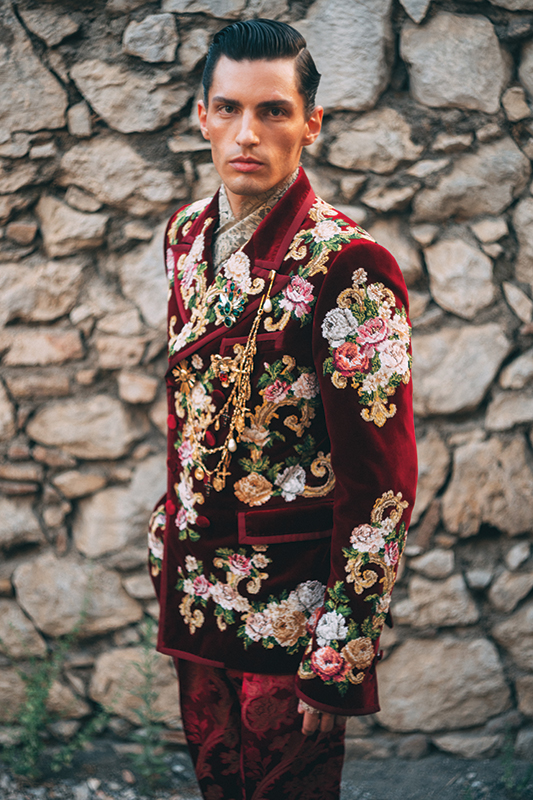
But beyond the desire to celebrate the terroir of Dolce & Gabbana, there is a business case to made for this extravaganza. The support for artisanal craftsmanship here has a halo effect for the brand. Particularly for the made-to-measure service that is available for men at Dolce & Gabbana’s flagship stores around the globe.
Take the Madison Avenue boutique in New York. Here, there is a special made-to-measure studio – as there is in Milan and London, too – replete with red velvet and gilt mirrors, like an opulent dressing room in a Milanese palazzo. A customer can come here to construct unique pieces, guided through the process by a Dolce & Gabbana tailoring expert. There are myriad choices of styles, fabrics, linings, and buttons, details which, taken together, ensure that the garment you co-create will not only fit your unique shape, but almost certainly be a one-off that you can genuinely claim as your own.
Your choices are recorded, the information sent to Milan, and in a few weeks you take delivery of your highly personalized piece of Dolce & Gabbana, made with the type of skill and care that broadcasts a love of traditional Italian artistry. This is the practical expression of the spectacle at Alta Sartoria. This is where the dream of that summer’s night in Sicily becomes a reality for men all over the world.





Comments