
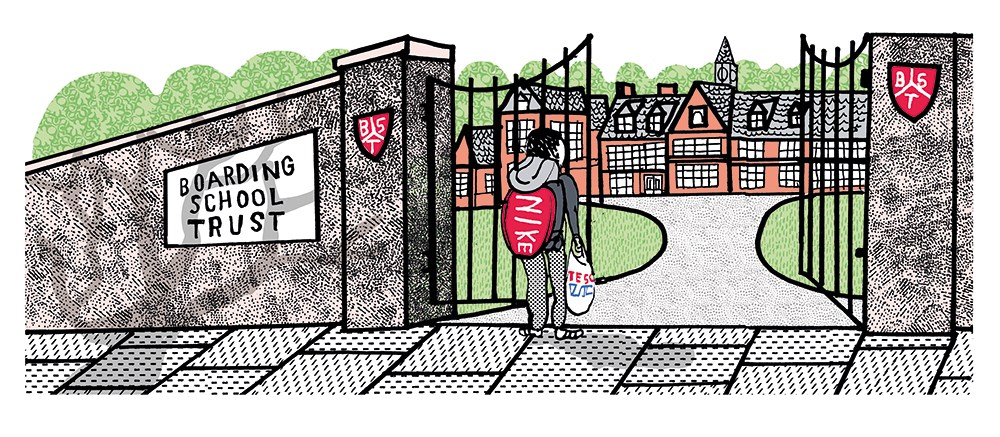
Since January, at least five boarding schools have announced their closure – including Thetford Grammar in Norfolk, which traces its origins to ad 631, and Rendcomb College in Gloucestershire, the alumni of which includes Kojo Annan, the businessman son of Kofi, and retired champion jockey Richard Dunwoody.
These closures are nothing compared with 2025 which saw a bonfire of private schools. Some 51 ‘mainstream’ establishments announced their demise (in addition to more than a dozen special schools).
Such schools could help children break free from patterns of behaviour in places where hope has gone
The cause, as you’ll know, is Rachel Reeves’s decision to slap 20 per cent VAT on private education in the 2024 Budget, as well as the end of business rates relief. The increase in employers’ national insurance was another nail in the coffin.
The question, then, is what to do with all these empty schools – especially ones like Rendcomb, which has 230 acres of grounds just outside Cirencester. They can’t all be given over to housing, can they? And how many retail parks does one country need?
Well, I have a suggestion for what we can do with these schools – we could turn them into, er, schools. Why don’t we take these boarding schools and nationalise them? Then we could make them available to children from poorer households – perhaps even with an emphasis on recruiting them from among the 2.2 million children who are eligible for free school lunches.
We’d probably have to find the brighter pupils. But then we could really get to work on them. Imagine what we could do if you take these children away from their failing communities a week at a time, or for several weeks or even a term at a time.
I accept that ‘failing communities’ is a hard term but we must confront the fact that if an entire family lives on benefits and nearly everyone that family knows does the same, then their children are unlikely to reach their full potential.
Worse still, those children are highly unlikely to hit the escape velocity required to break free from it all, and they may well end up following in the same unfortunate footsteps as their parents. But what if they could learn to free themselves and had their eyes opened to the working world beyond? Just think…
This is what state boarding schools could do: help children break free from communities and patterns of behaviour in places where hope has gone. They could help children avoid the doom-loop of Britain’s well-intentioned benefits trap.
By bringing these children to live in an area of supreme beauty, with an emphasis on academic rigour and excellence, on certain behavioural standards and on outdoor activities – ‘games’ for a better word – you would transform lives.
Yes, they might be homesick. But getting the progeny of Britain’s poorest families into an environment geared to success would be an act of supreme kindness.
It’s not such a crazy suggestion. There are already around 35 state boarding schools in Britain which offer much lower fees by charging only for accommodation (so usually costing somewhat less than half the private sector). These include Wymondham College in Norfolk whose former pupils include the Blair-era cabinet minister Stephen Byers and the Lib Dem coalition government minister Norman Lamb.
But plainly these schools are too few in number and are also aimed at families who can afford what the poorest in our society would still regard as astronomical fees.
What we need are boarding schools which are free to the kids who attend. This would include children such as the New Labour minister Lord Adonis, who went to a boarding school thanks to the support of his local authority.
As it stands, some 1.2 million children are raised in workless households and many will follow their parents, if only because they live in depressed areas where jobs are few and it’s far easier to get benefits than work.
Getting the progeny of the poorest families into an environment geared to success would be an act of kindness
State boarding schools would broaden kids’ horizons and rescue a proportion of these children from this fate. What’s more, some would go back and show left-behind communities that it’s possible to escape and to climb the ladder.
How many schools would you need? Well, if the government bought the five that are closing in 2026, that could give you perhaps 2,500 places a year. As well as transforming lives with more intensive education, improved nutrition and the potential for greater fitness thanks to more outdoor activities, there could be a greater emphasis on pastoral care, one which would give children an understanding of the attitudes needed to succeed and thrive, provided by adults who can model those behaviours too. Which not all parents can do.
This is one of the secrets to the enduring success of boarding schools and partly why the wealthy have embraced them. Those who can afford it invariably choose to send their children to schools that turn out nice, well-rounded individuals. Within that is a tacit acceptance they can’t do it by themselves.
If the wealthiest in society need such help, why should we expect the poorest to do without it, with all the disadvantages they’re already saddled with?
So how about it? Why doesn’t the government scoop up the five schools that have already gone bust and add in another five? Ten would be a good start. Why not lavish on children the equivalent of the treasure we might otherwise spend for decades to come in welfare – and along the way open these kids’ eyes to a more fulfilled life and give them the opportunity to reach their potential? I hope the new Education Secretary, Lucy Powell, is reading…






Comments