
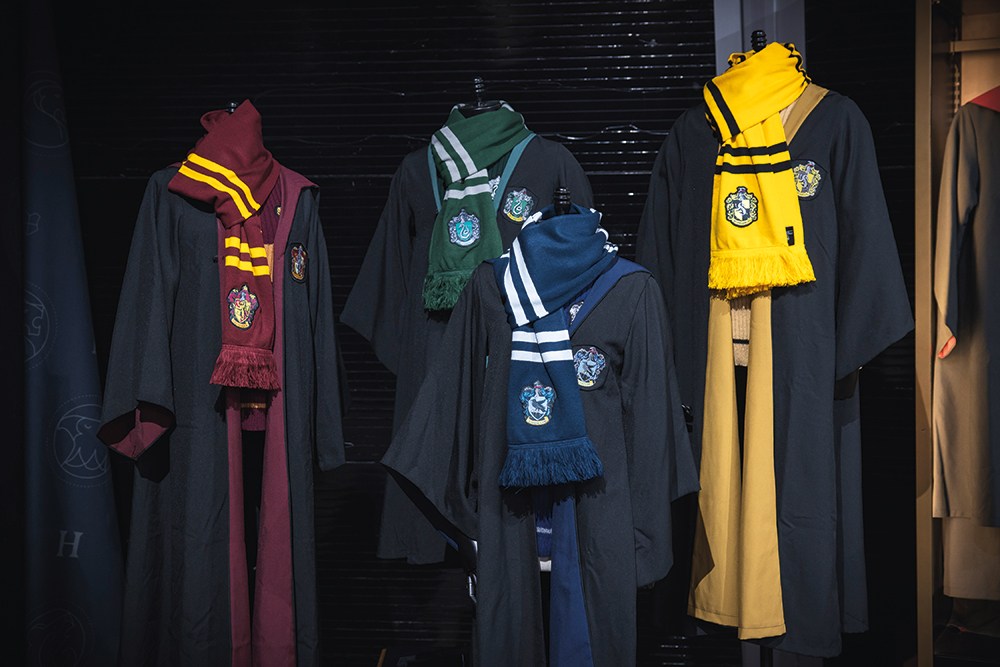
Worse ideas have been had at 30,000ft. On a flight more than 30 years ago, an aspiring young author had a thought and wrote four words on the first piece of paper that came to hand: Gryffindor, Hufflepuff, Ravenclaw and Slytherin. J.K. Rowling had just drafted the house system for Hogwarts School of Witchcraft and Wizardry on an aeroplane sick bag.
Each house, named after the founders of the school, had its own character and the children would be placed there by the Sorting Hat in a millinery Myers-Briggs test. Gryffindors were brave, Hufflepuffs were loyal duffers, Ravenclaws were hard–working and clever, and Slytherins were devious snakes. Or, as the Hogwarts staff room may consider them: gods, plods, spods and sods.
Houses at real schools may similarly acquire their own nature, shaped by the teachers in charge and the dominant personalities of certain children. The actor and author Sir Stephen Fry wrote in his memoir, MoabIs My Washpot, that certain houses at Uppingham, which he attended in the 1970s, were known for being scholarly or sporty. ‘One house might have a reputation for being messy and ill-disciplined,’ he wrote. ‘Another for being a hotbed of queering and tarting.’ Not perhaps a line for the prospectus.
‘One house might have a reputation for being messy and ill-disciplined. Another for being a hotbed of tarting’
Houses at Uppingham had names like Meadhurst, Highfield, Farleigh and Fircroft, which, as Fry wrote, sound as if they belong somewhere like Carshalton or Roehampton, ‘peeping through laurel bushes’. Another house, West Bank, was inevitably spoonerised. A house’s purpose, more than reflecting living space, was to give boarders a tribe to belong to as they moved up the school. It integrated new arrivals with old-timers to whom they might look up, and created a shared purpose for intra-mural rivalry on the sports field, in exams and as good citizens.
In Tom Brown’s School Days, Brooke, hero of the football field, gives a rallying cry to younger boys about why School House is tops. ‘It’s because we have more reliance upon one another, more of a house feeling, more fellowship than the school can have,’ he says. ‘Each of us knows and can depend on his next-hand man better.’ Rugby School, on which Thomas Hughes based his novel, now has 15 houses for boys and girls, with the day pupils given their own bases in Southfield and Town House, once home to William Webb Ellis, whose ‘fine disregard for the rules’ in games led, according to legend, to the sport that was named after the school.
While the 25 houses at Eton College are known by the initials of current housemasters, others have honoured historical worthies. At Wellington College, many of the houses are named for those connected to their eponymous general such as Anglesey, after a marquess who lost part of a leg at Waterloo, Blücher, for the Prussian field marshal, or Hardinge, who served in Wellington’s cabinet. There is also a house that bears the family name of Wellesley and one named Apsley after his house. Surprisingly, there isn’t a Copenhagen house after his horse.
So successful was the system as a model for building a community that it was adopted in the late 19th and early 20th centuries by non-boarding independent schools and then in the state sector as well as around the Commonwealth, with names taken from historical figures, alumni or local landmarks when there was no physical house or housemaster.

At Braunton Academy in north Devon they are named after beaches – Croyde, Putsborough, Saunton, Woolacombe – while the Holt School in Wokingham has eight houses named after guilds, from Broderers to Weavers. My primary school, on Mersea Island off the Essex coast, had ships rather than houses, each named for an admiral – Nelson, Drake, Grenville and Beatty – and they would compete in sport for the Bombshell Trophy after a missile that landed on the school.
My secondary school, Colchester Royal Grammar, named its houses after three of its former head-masters. This was in 1908, an initiative of the then head, Percy Shaw Jeffrey, who, in wanting to compete in ethos with the private schools, also created a school song, magazine and alumni society, and dressed the boys in purple blazers. None of the named heads had spent very long there but they were oddly felt to be suitable role models. Samuel Harsnett left the post after 18 months, saying he found teaching a ‘painful trade’, but became Archbishop of York; Samuel Parr, a Whig polemicist whose writing was said to have the pomposity of Samuel Johnson but none of the wit, lasted about the same time in 1778-79; while William Dugard, a propagandist for both Charles I and Oliver Cromwell, stuck with it for six years. A fourth house was named in 1950 for Shaw Jeffrey, who was head for 16 years. The same four names are still used, though there are now 750 more pupils than in Shaw Jeffrey’s peak.
Inevitably, there are some who wish to erase historical names. In January, it was reported that students at Hinchingbrooke School in Cambridgeshire had voted to remove Samuel Pepys’s name from one of its houses because of his behaviour towards women. In 2024, Dulwich Prep scrapped the Native American house names of Chippeway, Deerfeet, Mohican and Ojibwa, which had been used since 1916, and replaced them with Phoenix, Pegasus, Gryphon and Lamassu, the last a Mesopotamian mythical beast.
Three years earlier, in 2021, at the height of the fashion for signalling a social conscience, Howden Junior in East Yorkshire had ditched Drake, Nelson and Raleigh and replaced them with Greta Thunberg, Marcus Rashford and Malala Yousafzai. One wonders who will have heard of them in even 20 years, never mind a few hundred. At around the same time, J.K. Rowling was replaced as a house name at Boswells School in Essex, which had decided her opinions on trans issues ‘do not align with our school beliefs’. Never mind that Rowling has done so much to encourage children to read and had raised the concept of the house system as a good thing – her support for women’s rights was too problematic for the Dementors.




Comments