Politics

Read about the latest political news, views and analysis

Coronavirus won’t change Boris Johnson’s Tory party

Whisper it softly but one day, eventually, politics will come back. And while it might not be the thing we’re all missing most, when it does a lot will hinge on what form it takes. As James Forsyth noted in his column this week, talk in government is that politics will be changed ‘for a generation’ by the Conservative party’s move to become a more ‘communitarian party’. Yet prior to the shock of the pandemic all the talk was of a new divide in British politics. Social values – not the traditional left-right cleavage – was the dominant dividing line that won Boris Johnson his majority. Now the talk is of a country, post Brexit and post Covid-19, more united.

Will Sweden’s social distancing-lite work?

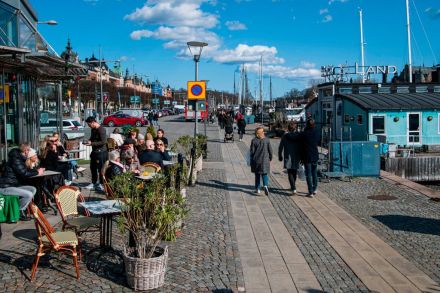
The science of epidemiology relies a lot on modelling because, for obvious reasons, controlled experimentation would be unethical. But in the case of Covid-19 we do have something approaching a real-life experiment – in that Sweden has declined to follow other European countries into lockdown. Instead, it has followed a policy which might be summed up as social distancing-lite. Gatherings of more than 50 people have been outlawed, closing theatres and putting an end to sports events. But children up to the age of 16 are still attending school, shops and restaurants are still open – albeit with rules preventing people standing up at the bar – and no police officer is to blow a whistle at you for sitting on a park bench.

Sunday shows round-up: ‘Grotesque’ to suggest the PM skipped meetings, says Gove

Michael Gove – Government is not thinking about lifting lockdown restrictions yet Sophy Ridge began the morning interviewing the Cabinet Office Minister, Michael Gove. On Thursday, the government announced it would be extending the UK's lockdown for a further three weeks to best tackle Covid-19. Gove downplayed reports that the government had drawn up a three-stage plan to end the lockdown, and explicitly quashed the idea that schools could be open again from mid-May. Instead, he told Ridge that the government's efforts would continue to be guided by the science, and would not be drawn on a timescale: https://twitter.com/RidgeOnSunday/status/1251781184553652224?

The government’s coronavirus mantra avoids its systemic problem

Paul Marshall makes the compelling point that mistakes have almost certainly been made by scientists and Public Health England. However, in the British system, power lies not with the scientists and officials, but with elected politicians. And I have been concerned since the start of this outbreak that ministers were using the expert advice of the scientists and epidemiologists, and the recommendations of the assorted expert committees, as a reason not to take responsibility for life-and-death decisions. ‘We're following the science’ has been the ministerial mantra and cliché of this crisis. And if we've learned anything in this crisis it is the limits of scientific knowledge in respect of a new virus. What matters, I think, is not the precise date of the lockdown.

Do face masks work? A note on the evidence

Should we, or should we not be compelled to wear face masks during a virus epidemic? It sounds a simple enough question. Indeed the answer seems so obvious to many, including the Mayor of London, Sadiq Khan, that they are questioning why this measure is not already mandatory. Surgeons wear them; they filter the air we breathe; viruses are in the air; let’s get everybody wearing them. Other countries have, so they must be helpful. It seems so straightforward. Unfortunately it’s not as simple as that, and the obvious becomes less obvious the more you look at it.

The unspoken truth about home school: poorer children will suffer

This week, school starts again, but not in anything like the normal way. Were it not for Covid-19, millions of children would wake tomorrow to the familiar routine: a hurried breakfast, perhaps a panicked search for missing shoes or a stray jumper, then a dash to avoid being late. Instead, what awaits young minds that would otherwise be trying to learn? In this strange new world, where each family and household gamely tries to find its own way from the start of the day to the end, there are probably only two certainties around education. First, the BBC, which tomorrow unveils the biggest slate of educational programmes in its history. Second, the jokes, the social media jokes from parents juggling work and the improvement of the next generation.

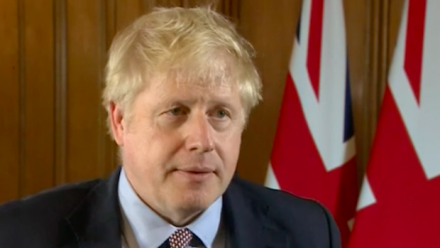
What the country needs most is Boris Johnson back at his desk

Boris Johnson has been out of action for almost a fortnight. His last meaningful act before going into hospital was to force frazzled Health Secretary Matt Hancock to ditch a threat to ban outdoor exercise that he’d made live on TV in response to some tweeted pictures of people sunbathing in a park. In place of that threat, Johnson’s Downing Street changed the tone by sending out a message telling the British public 'thank you, thank you, thank you' for their efforts. Though the Government initially claimed Mr Johnson would work on his red boxes and receive briefings while in hospital, this did not actually happen (no doubt due to his rapid deterioration). Downing Street confirmed on April 13: “He didn’t receive any papers while in hospital.

Why isn’t the UK testing at full capacity?

14 min listen

The government revealed today that its testing capacity is at 38,000 a day. So why, then, are less than 16,000 tests being taken each day so far? Cindy, James, and Katy also discuss the new vaccines task force, the extension of the furlough scheme, and what the latest numbers out of China mean.

Stanford study suggests Covid infections are 50 to 85 times more than confirmed cases

Another day, and yet more evidence has appeared that could indicate the number of people who have been infected with SARS-CoV-2, the virus which causes Covid-19, might be vastly higher than official figures suggest. This time a Californian study suggests the figure in one county could be more than 50 times the number who knew they had had the virus. A team from Stanford university and other US universities recruited volunteers in Santa Clara County via Facebook adverts and produced a sample of 3000 representatives of the county as a whole. They were then invited for blood tests to detect the presence of antibodies to the virus. The result was positive in 1.5 per cent of cases. Adjusting for age, gender and ethnicity the results suggest that 2.

When will the public accept an end to the lockdown?

In the weeks leading up to Boris Johnson announcing lockdown measures, ministers and aides wondered how in the world you could enforce a lockdown like the one seen in authoritarian China in a liberal democracy such as the UK. But following Dominic Raab confirmation on Thursday that there will be another three weeks of lockdown, public resistance is the least of ministers' concerns. The biggest surprise about the lockdown within government has been the level of public support for it. Polling has repeatedly shown that rather than fighting the social distancing measures, Britons are embracing them more obediently than anyone in might have dared imagine.

The scientists are now running the country

What we learned on Thursday is that, at least while the Prime Minister is convalescing, the boffins of the government's Scientific Advisory Group for Emergencies are, in effect, running the country. Dominic Raab, who is deputising for Boris Johnson, made it crystal clear that he and his fellow ministers – who met on Thursday in Cabinet and the Cobra committee – simply followed the advice of SAGE, which is chaired by Sir Patrick Vallance, in extending total lockdown for a minimum of three weeks. As other ministers have confirmed to me, there was no pushing back on SAGE's view that easing any of the current unprecedented constraints on our basic freedoms would lead to another surge in Covid-19 infections that would damage our health and the economy.

The five tests for easing the lockdown

15 min listen

As expected, Dominic Raab announced an extension to the lockdown today, with no clear end date set. But he did offer insight into the criteria that the government is using to judge when that time might come. Katy Balls writes about it here and she discusses them on the latest episode with James and Cindy. The difficulty comes from tests four and five - in particular, some in government tell James that the goal to carry out 100,000 tests per day may not be met until mid-May. In this episode, James also reveals that the government is considering changing its advice on masks.

Corona wars: will either Trump or Xi win?

44 min listen

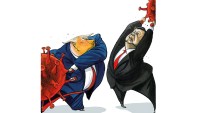
Historian Niall Ferguson writes in this week's cover piece that, even before coronavirus, the Cold War between America and China was already getting underway. With the current pandemic, animosity between the two superpowers has only increased. So when it comes to the geopolitics of the 'corona wars', who will win? Niall tells Cindy on the podcast that it may not be either; that when it comes to pandemics, city-states actually do better than empires. That's the Taiwans, the South Koreas, and the Singapores. He's joined on the podcast by Gerard Baker, the editor at large of the Wall Street Journal.

Dominic Raab’s five tests for easing the lockdown

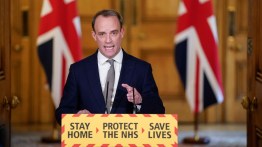
Dominic Raab has this evening confirmed that there will a lockdown extension of three weeks. The First Secretary of State said that while there had been encouraging signs that the rate of infection had significantly reduced, it was still too early to break away from any lockdown measures. He said the most dangerous thing for both public health and the economy would be a second wave of coronavirus infections. While the government line remains that ministers will not publicly discuss an exit strategy on the grounds that it distracts from the current social distancing measure, Raab went the furthest he has in addressing the issue.

Prepare for a radically different Tory party

Before he went into isolation, Boris Johnson had remarked to Downing Street aides that he was keen to get back to the agenda on which he had been elected. But as I say in the magazine this week, this virus has now so changed the landscape that there will be no simple return to the world before coronavirus. One normally understated Downing Street figure predicts it will ‘change things for a generation’. The question for the government is whether it wishes to attempt to return to what went before or to try and combine its various agendas – levelling-up, Brexit and net zero – in its post-Corona reconstruction job. Currently, all the signs point to the latter.

Why Trump and Xi might both lose the corona wars

The Covid-19 pandemic came along just as Cold War II was getting under way between the United States and the People’s Republic of China — the superpowers of our time — with the European Union and a good many other US allies quietly hoping to be non-aligned. Far from propelling Beijing and Washington towards détente in the face of a common enemy, the new plague has only intensified the Cold War. For the first time, China’s campaign of disinformation has been on a Russian level, with wild anti-American conspiracy theories being disseminated by senior Foreign Ministry officials.

How Covid-19 will change the Tory party

Politics is full of events that are meant to change everything but actually do little. Yet the coronavirus crisis will be one of those rare events that does have lasting political impact. This disease, and its aftermath, will change how the country works. Covid-19 has already directly affected every household, business and institution in the country in a way that not even the 2008 financial crash did. Boris Johnson’s government will now be defined by how it handles both the crisis and its aftermath. Before he went into isolation, Johnson remarked to Downing Street aides that he was keen to get back to the agenda on which he had been elected. This virus has so changed the landscape now, though, that there will be no easy return to the world before corona.

Shame on those who mock Matt Hancock’s ‘care’ badge

Matt Hancock’s badge for carers is a perfectly good idea. The mockery of it is in many cases shallow, ill-informed, revealing and hypocritical. You don’t need me to describe the badge or the mockery. Anyone with an internet connection and a glancing familiarity with what passes for 'news' these days is aware that the Health – and Social Care – Secretary announced that the Government is now backing a scheme that encourages social care staff to wear a green badge saying CARE. Part of the aim is to give care workers the same sort of recognition, esteem and access to services – reserved shopping hours, for instance – as NHS workers. This is reasonable, necessary and overdue.